“The Wogglebug doesn’t just generate random voltages—it generates random voltages that do interesting things.” - Grant Richter
Introduction
The Wogglebug is a legendary random voltage generator originally designed by Grant Richter of Wiard Synthesizers. Inspired by Don Buchla’s Model 265 “Source of Uncertainty,” the Wogglebug expanded upon classic “smooth” and “stepped” random voltage sources to include “woggled” control voltages—stepped voltages with decaying sinusoidal edges.
The design has been produced in multiple formats: the original Wiard 300 series, Frac, Eurorack, and 5U.
Original Wiard 300 Series Wogglebug
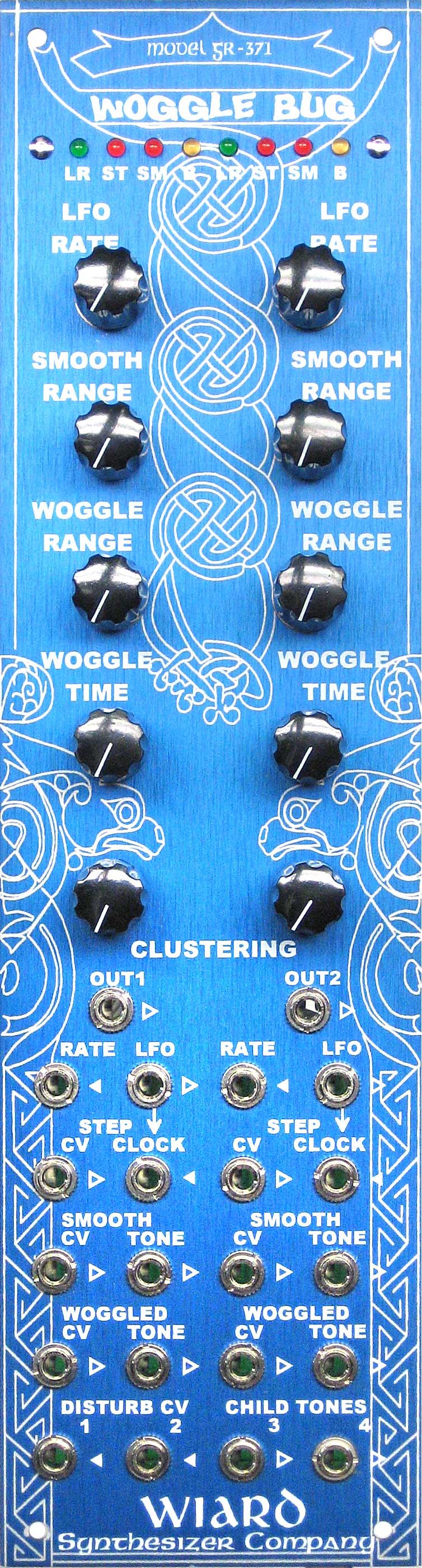
The original Wiard Wogglebug (Model 371) was introduced in 1999 as part of the Wiard 300 series—a 6U high, 19” rack-mounted format. Grant Richter designed it as a self-contained random voltage source that could drive entire patches on its own.
The module contains four permanently coupled audio VCOs with ring modulation alongside a full random voltage system. It produces stepped, smooth, and “woggled” random CVs in the 0-10V range, plus random burst triggers and clock generation with Phase Lock Loop capabilities. Richter described it as containing the equivalent functionality of 18 electrical modules.
Frac Format Wogglebug
The Frac format Wogglebug (Wogglebug #3) is an extremely rare version produced by Make Noise in the compact Frac modular format. Approximately 2 Frac units wide, it maintains the core functionality of the original Wiard design including clock generation, CV modulation outputs (stepped, smooth, woggle), integrated oscillators, and ring modulation.
This version is noted to be closest to the original Make Noise Wiard implementation rather than later Eurorack versions. Due to the Frac format’s size constraints, some consideration was given to even more compact layouts, though this would have required omitting features. The extreme rarity makes it a sought-after piece for Frac system users and collectors.
Make Noise Richter Wogglebug (V1)
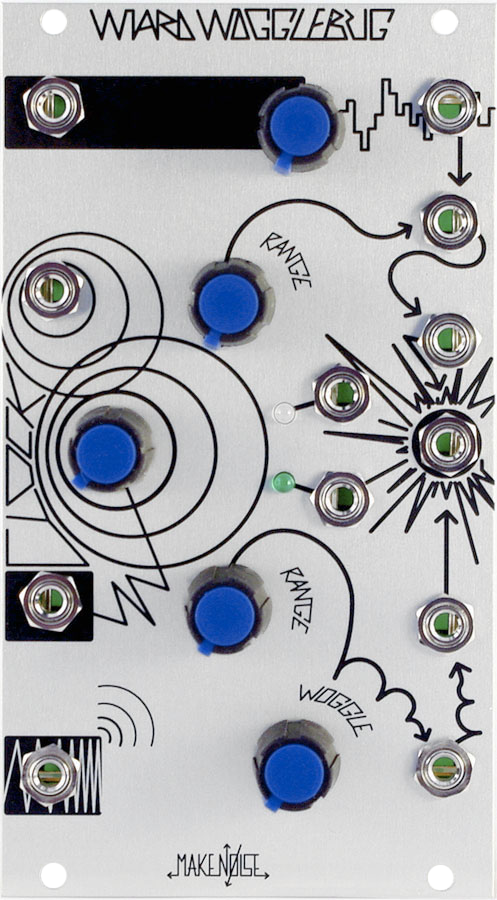
Released around 2014, the Richter Wogglebug was Make Noise’s first Eurorack adaptation, produced with Grant Richter’s permission as a tribute to the original. At 10HP and 24mm deep, it draws 50mA at +12V and 40mA at -12V.
The module generates seven random signals simultaneously across three sections. The Random Audio section provides smooth VCO audio, woggle VCO audio, and their ring-modulated combination. The Random CV section produces stepped, smooth, and woggle random voltages (0-10V). The Random Clock section generates random burst triggers with an internal clock and sample & hold circuit.
Controls include Speed, Chaos, and Woggle knobs, plus Rate CV input, Influence input, and a Disturb button for manual intervention. This version includes individual range knobs for each VCO and has “more of a mind of its own”—prized by users who want maximum unpredictability.
Make Noise Wogglebug (Current)
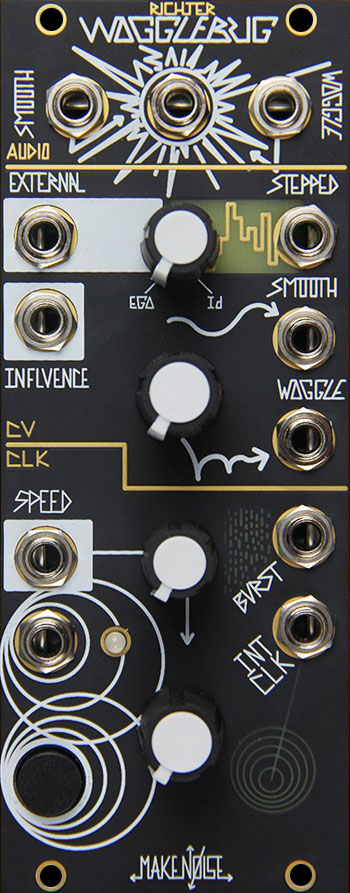
The current Wogglebug represents a refined evolution, maintaining core functionality while improving stability and musicality. Same physical specs as V1 (10HP, 24mm deep, 50mA +12V / 40mA -12V) but with significant improvements.
The module still generates seven random signals: three audio outputs (smooth VCO with new Sharktooth waveform, woggle VCO, and ring mod) plus three CV outputs (stepped, smooth, and woggle 0-10V) and random burst triggers. The clock is now much more stable with the widest frequency range yet—up to approximately 200Hz, allowing outputs to function as analog/digital noise sources.
Key improvements include the new Sharktooth waveform for the smooth VCO, greater influence from the Influence input, more active burst output, and fixed (optimized) VCO ranges rather than individual range controls. The clock can now be freed by external clock input or Disturb button while maintaining its specified rate, and it’s no longer locked to the internal sample & hold circuit.
This version is more of a “team player”—better suited for melodic and rhythmic applications than V1, but still chaotic when you want it to be.
LWSS 5U Wogglebug
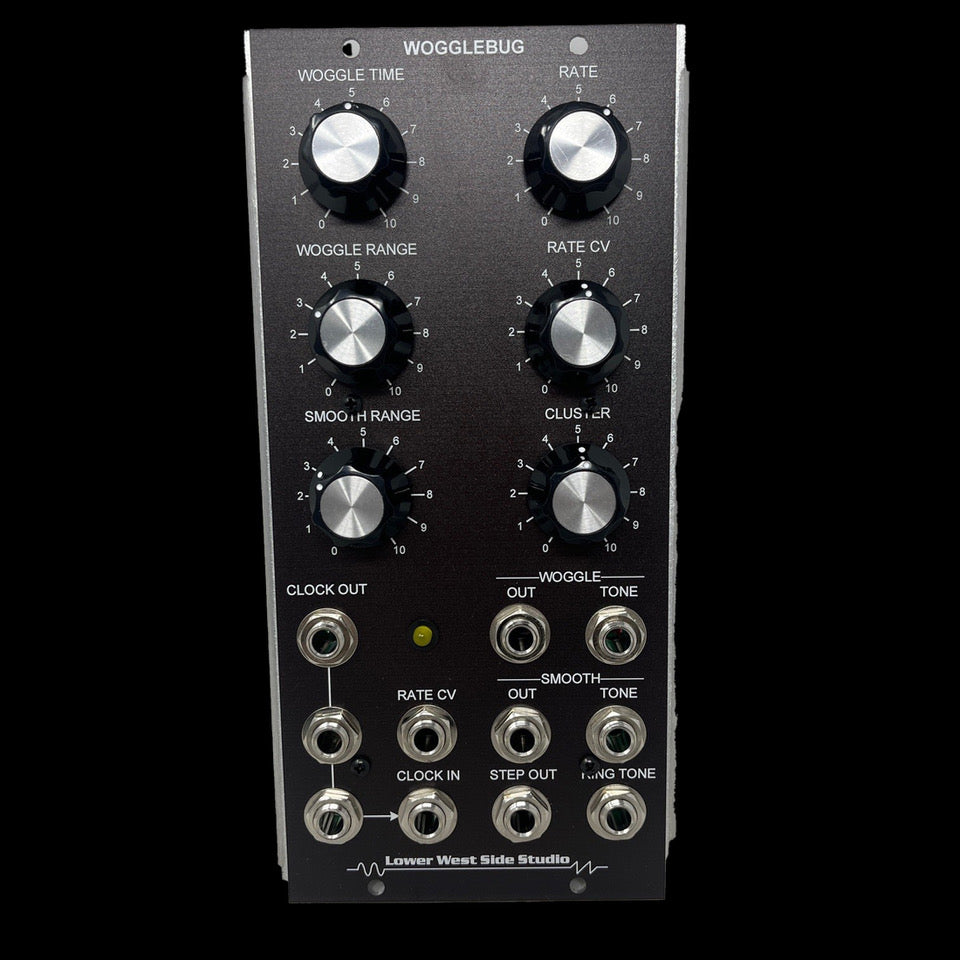
Lower West Side Studio (LWSS) produces the Wogglebug in 5U format for Moog Modular-style systems. Priced around $346-365, it has the complete Wiard Wogglebug feature set in large format.
The 5U format gives you native 0-10V operation matching Moog specs, bigger panel with comfortable knob spacing, and standard 5U power. It has all the random voltage generators (stepped, smooth, woggled), audio oscillators with ring modulation, and clocking/triggering capabilities including internal clock, external clock input, random burst generator, and Phase Lock Loop system.
The larger format is comfortable for live performance. In 5U systems it typically serves as a random modulation source, a chaotic element for sequenced patterns, or a way to keep static patches moving.
The Woggle Concept
All Wogglebug variants share the same core ideas: chaos you can nudge but not fully control, a self-contained random voltage source that works at both CV and audio rates, and patches that develop on their own over time.
The defining feature is the “woggle” output—a stepped random voltage with decaying sinusoidal edges. It sits between fully stepped and fully smooth randomness: more movement than stepped, more defined events than smooth, with a “bouncing” quality and complex harmonic content at audio rates.
Legacy
The Wogglebug is one of the most influential random voltage generators in modular synthesis. Richter’s expansion of Buchla’s uncertainty concepts has shaped how later designers approach random modulation, and the “woggle” concept has been referenced in numerous modules since.
That it’s still being produced across four different formats — Wiard 300, Frac, Eurorack, and 5U — says something about the design holding up.
Sources: Wiard 300 Series • Make Noise Wogglebug • Patch & Tweak Article • LWSS at Noisebug