The MiniMoog Synthesizer was conceived of and put into production at the original R A Moog Inc. company in Trumansburg, a small town 13 miles north of Ithaca New York. The entire operation, offices, engineering and production, took place in the former Baldwin’s Furniture Store on Main Street. Product development there was a fast paced and freewheeling affair in an engineering dominated environment. In the two years that I worked at that location, from the fall of 1969 to the fall of 1971, there were four or five of us design engineers in a company which averaged about 30 employees. We pursued an overly ambitious slate of projects; an electronic music studio mixer, the highly advanced (for its time) Moog-MRS multi-track tape recorder, the continuing evolution of the mainstay 900 Series Modular Patchcord products, an educational (classroom) synthesizer, and the fulfillment of a backlog of one-of-a-kind specials Bob Moog had contracted to deliver to various studios, universities and individual composers. We also cobbled together modular components for live performances, the most notable being several built for composer-in-residence Chris Swansen and fellow performers for a landmark “Concert At the Garden” in New York City in 1970. One of these was later sold to a British musician none of us had heard of at the time named Keith Emerson.
Gene Zumcheck was Moog’s first staff engineer, and he was the first to push for an instrument designed from the get go to be used for live performance by a gigging musician. He was responsible for the first step in this direction, the Model 10 Synthesizer. It consisted of an assembly of existing 900 Series modular components mounted into a single standard portable cabinet and played from a separate stock 951 keyboard. It had provision for an auxiliary ribbon controller to be used for pitch bending. Gershon Kingsley’s First Moog Quartet performed on four of these instruments in a concert given in Carnegie Hall in 1970. Although still a patchcord machine, the Model 10 was a direct evolutionary step in the progression from modular to true live performance synthesizers.
Zumcheck and Bob Moog did not get on together too well, and somewhere around the time the Model 10 hit the streets, Gene was impelled to hit the road himself. He went to Buffalo New York and became the key figure in the development of the Sonic 5 Synthesizer. Fellow Ukrainian and wheeler-dealer Bill Waytena organized a company named Musonics Inc. to produce it. Eventually Moog and Musonics merged in Buffalo and poor old Gene ended up being fired by Moog a second time.
Meanwhile back in the Moogworks in Trumansburg, we were in a lot of trouble due to poor business management, barely meeting payroll and trying to attract investors without much luck. Moog, bless his heart, was giving his all to advance the art of music with electronic innovations and spending much of our resources without much return on investment, much to the chagrin of our hard nosed business manager John Huzar. Bob hadn’t a particularly strong interest in the development of a production model live performance instrument, with the boring prospect of manufacturing hundreds of identical instruments on an assembly line. He loved to design custom “specials” in collaboration with artists. After all, that was the genesis of the original synthesizer modules. The others of us designers, me, Bill Hemsath and Chad Hunt, along with Huzar and sales manager Al Padoor, were quite keen to develop what we initially dubbed the “integrated” (i. e., non-modular) synthesizer which would retain the great “Moog sound”, yet be inexpensive to produce, road rugged and simple to operate (no patchcords). Somewhat reluctantly Bob relented and allowed development to start along this line, realizing as did we all that our company could not survive without an infusion of capital, and this would not be forthcoming unless we had a product an investor figured he could make a buck on.
We had in the Trumansburg factory a full electronic music recording studio which brought us musical engineers into constant contact with performers and composers. Some were local regulars (ed note. Chris Swnason, David Borden and Steve Drews among them). Others visited from afar to get instruction in the operation of their synthesizers. Still others were prospective customers needing advice on what suite of modules to include in their purchases. This engendered a lively exchange of insight, ideas, opinions and conjectures as we engineers strove to meet the needs of our collaborators and customers, either with novel patches or with design innovations. We observed that over and over again musicians would patch a voice in pretty much the same way: a bank of two or three tone oscillators feeding into a voltage controlled filter / amplifier chain with two envelope generators to contour the attack and decay of timbre and volume. Often a low frequency oscillator would be used to modulate pitch or volume to produce vibrato or tremolo. Finally the ribbon controller, a continuous slide device operated in a fashion similar to that of a violin string, would be connected to the tone oscillators to allow for pitch bending. This “voice” concept was first incorporated into the Synthesizer 10, on which the MiniMoog was rather closely modeled.
So it occurred to us to package this arrangement of functions as a fixed patch with limited ability to program interconnections and modulations, and to call this our live performance synthesizer. Chad Hunt and Bill Hemsath took the bull by the horns over a weekend, gathered up a bunch of 900 Series modules, went to the shop and cut up some walnut for a case to house them, built in a sawed off keyboard, wired the modules together in the back, added a slide pot to emulate a ribbon pitch bender and, viola!, on Monday morning there stood the MiniMoog Model A on the bench.
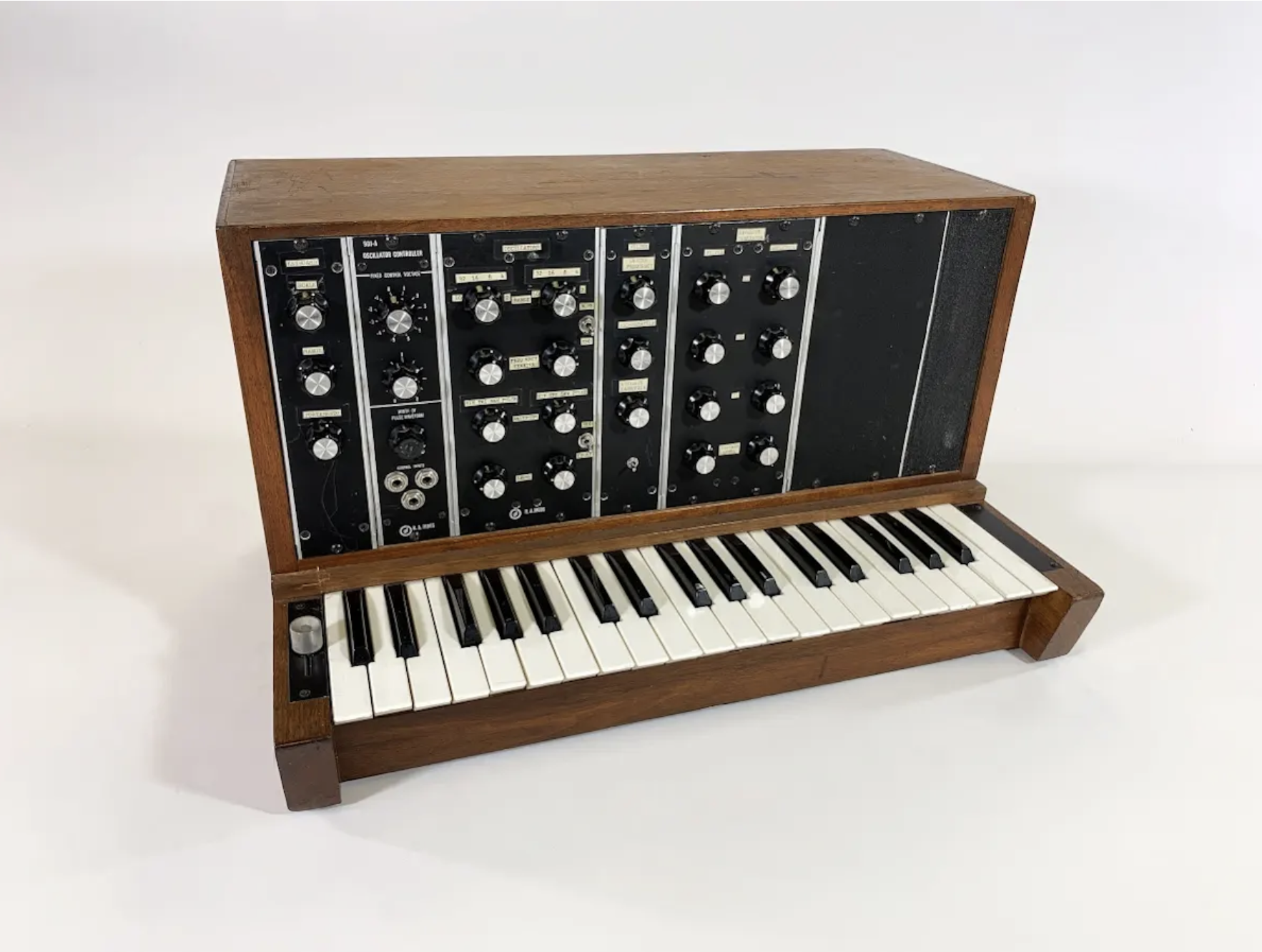
Bill wanted to call it the “Min” and so named it on the rear panel label. He and business manager John Huzar had quite a contest of wills over this, as John insisted (and eventually prevailed) that it be called the “Mini.” In any case that one instrument was an instant hit with the likes of composers David Borden and Chris Swansen, both studio regulars. I can’t remember whether the Model A happened before or after Huzar prodded Moog into letting the project proceed, but I suspect it was before.
Under Hemsath’s leadership the engineering department produced two Model B MiniMoogs. These employed standard modular circuit boards which were wired in behind a single “integrated” panel, whereas the Model A sported standard modular front panels reworked to delete the patchcord jacks. The electronic and functional design differed little from the Model A - it was just another repackaging job.
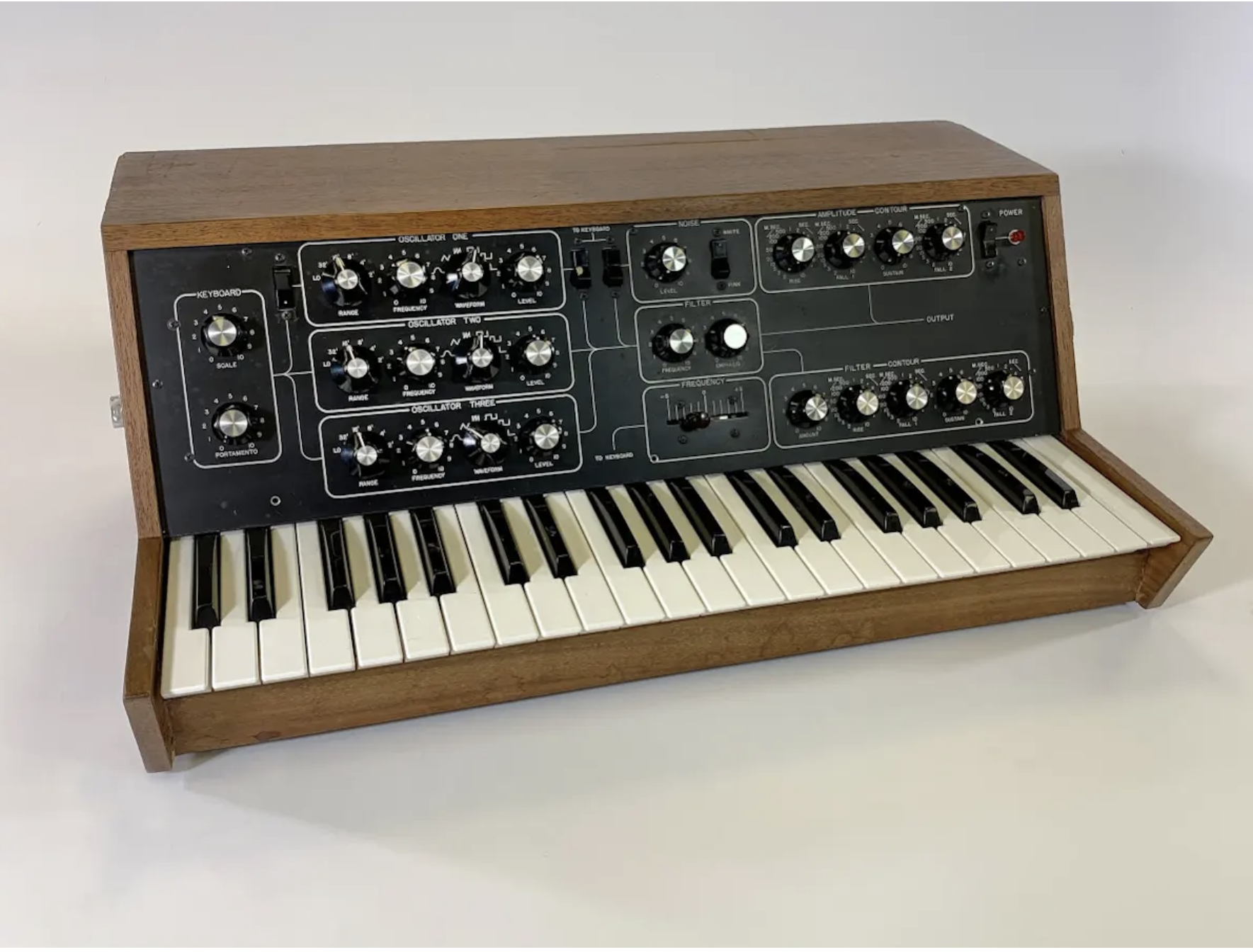
Realizing that the two B Models wouldn’t generate enough interest in the marketplace, Moog gave the go ahead to produce four C Models. The idea was to get the some instruments which looked and played like production models into the hands of our regional sales reps in order to gauge their reactions as to the sales potential. For these units we totally redesigned all the circuitry to simplify them to the essence, streamlining Bob’s original studio system designs and removing superfluous functions. We added a half octave to the keyboard, both in response to commentary by musicians and because the width of the control panel dictated a longer overall size. For test equipment we had not much more than oscilloscopes, voltmeters and our ears to guide us. The cabinet, with it’s fold down panel, was put pretty much in its final form. This was Bob’s idea I think, allowing for compact travel stowage and excellent viewability in performance. Each of us four designers took a portion of the circuitry to work on, Moog the oscillators, Hemsath the power supply, Hunt the modulation circuitry and me the filter / amplifier and associated envelope generators. The electronics were assembled by our production people, hand wiring point-to-point on one side of perforated “vector boards” with the components (transistors, resistors, capacitors, etc,) on the other. On this model the left hand control section took shape with a modulation-injection slide pot being added to the pitch bender.
The C Models received a good reception, but there weren’t enough of them to stimulate a worthwhile demand. We needed to get more units into the hands of musicians and onto the stage to make potential customers aware of the MiniMoog’s existence. Now in those days Bob Moog was quite in demand as a speaker and demonstrator of synthesizers. I believe he actually made his living from the income thus derived without drawing a salary from R. A. Moog Incorporated. Thus he got paid to publicize his business and promote sales, nice work if you can get it. As he departed for a couple of weeks on the road, he authorized the construction of 10 more C Models.
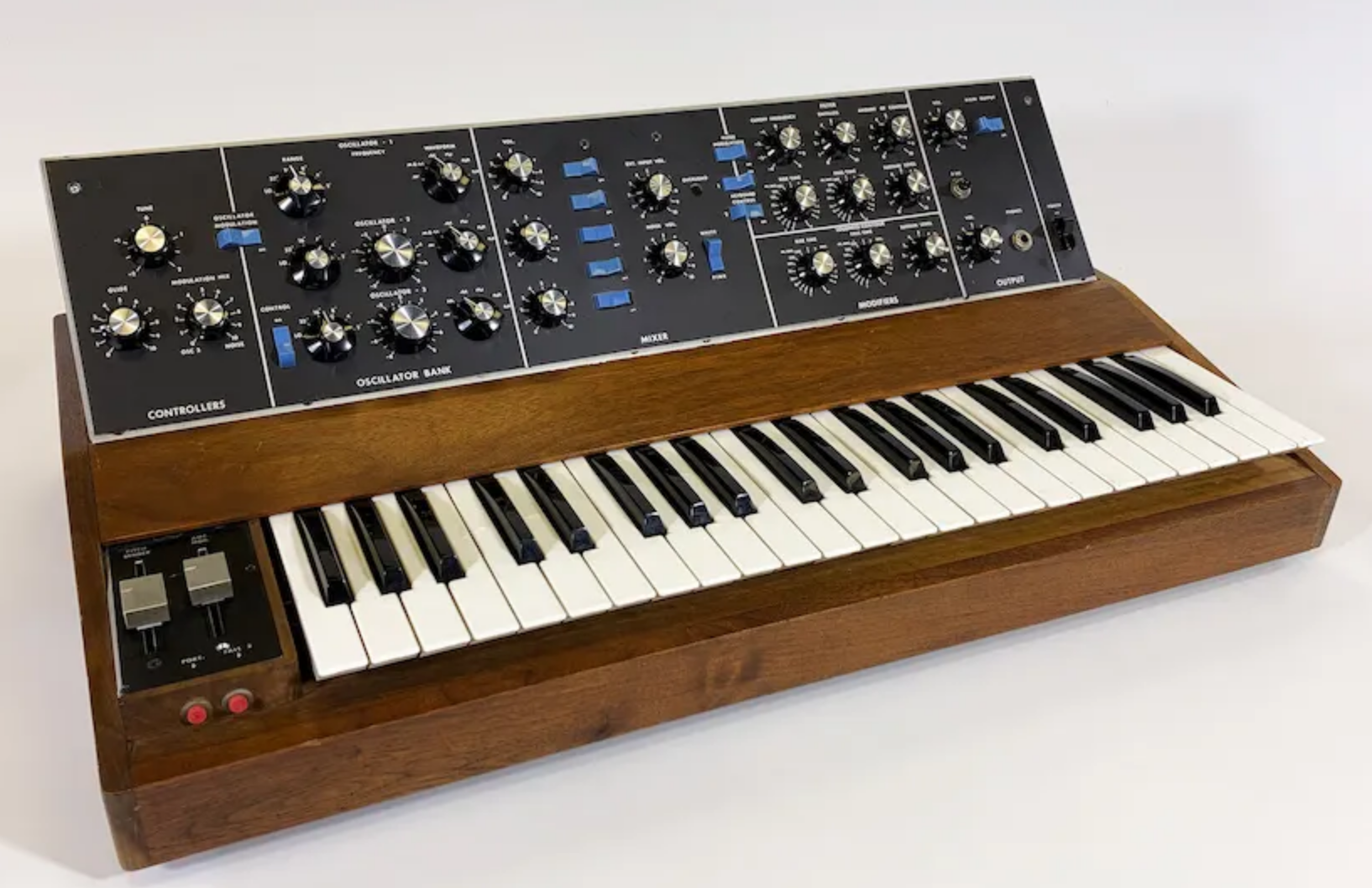
Hunt Hemsath and I laid out the PC boards. Draftsman Jim Ameigh laid out the front panel, then went to the shop and bent up the metal to form the electronics box behind it. After that he built the walnut cabinet to fit the keyboard and box. He did the drawings later. Moog wanted someone to come up with some sort of spring loaded rockers, like keys hinged in the middle, to replace the clumsy left hand controller slide pots, but none of us could figure a practical way to implement this. Our purchasing agent, Don Pakkala, a former tool and die man, ended up machining wheels for this purpose. Bill Hemsath gets the credit for inventing the wheel by the way, the first being constructed by him for the studio to facilitate control of modulations. So the first run of D Models was completed. Somewhere along here, in the transition from C to D, Huzar designated me as project leader, taking the load off Hemsath, who was heavily engaged in his ill fated studio mixer project. I did the production engineering and ran the MiniMoog show until the company was sold and moved to Buffalo the following year.
Swiss bell ringer and former evangelist David Van Kovering got his hands on a Model D, put on his super salesman hat, and beat the bushes down in Florida. Single-handedly he proved that synthesizers could be sold by Mr. Music Dealer, taking the lion’s share of our first few hundred Minis and selling them all in one state. The rest is history. Eventually we sold 12,000 of these Model D “prototypes,” and the instrument went on to become the main cash flow generator for the company for some five years before it became obsolescent and was retired from production. We never did get around to the E Model, the envisioned “real” production model in which the wiring harness would have been replaced by a circuit board which also would have carried the front panel pots and switches. There never seemed to be the time or funds to do the job right.
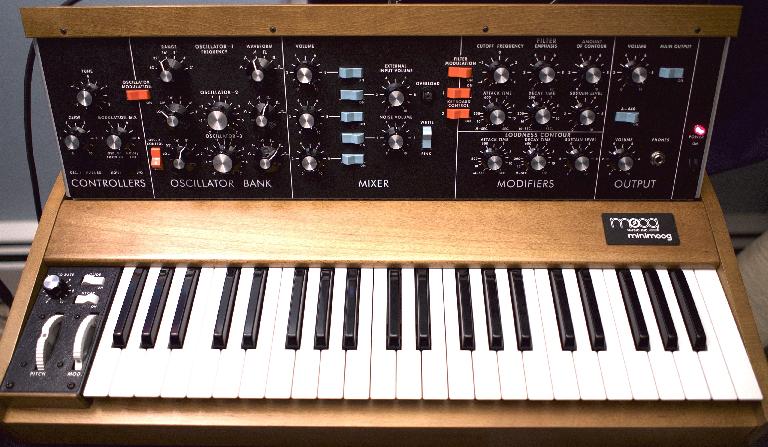
So the question remains, why does this instrument, designed in great haste, six months from concept to first delivery, sound so damn good? Why is it that that most of the MiniMoogs ever built are still being used today, some 25 years after the last one was manufactured? The answer I think, besides pure dumb luck in some aspects, lies in the use of our ears as our most trusted development tool and because we adapted to the Mini the rather obsolescent but well proven circuit technology developed by Bob Moog for its 900 Series modular predecessors. The original Mini had no integrated circuits whatsoever in it. None of us knew how to design with them back in the bad old days and none of us had the time to mess around with anything unknown. All circuitry was implemented using discrete (individual) transistors. This resulted in a very wide-band audio chain with no feedback anywhere, which unlike IC op amp implementations when driven into distortion, did so softly like a vacuum tube amplifier, without clipping the waveforms. This allowed us to drive the circuitry rather hard, which we did to achieve a good output signal-to-noise ratio. As a result, each of the several stages of the sound chain ended up contributing a fortuitous gentle distortion which enlivened the sound. The ultrasonic bandwidth preserves the high frequency cross modulation components (far above the audible range) which are produced in this process, and which the distortion in later stages causes to reappear downshifted back into the audible range. This is probably a vital factor in the famous “fat” sound of the early Moog instruments. And then there’s the Allen Bradley “Type J” carbon composition potentiometers on the front panel which carry the audio signals. In the early 80’s, Moog power amplifier engineers Pearce and Persival (?spelling?) discovered the source of distortion in their designs - it was due to the non-linearity of these pots. So maybe that has something to do with the sound too. Be that as it may, a look at the Mini sawtooth output on a scope with the filter wide open reveals a highly curved waveform, particularly when all three sawteeth are being mixed together at maximum level. Knowing how engineers think, I’m pretty confident that many designers of later instruments made the error of striving for perfect wave shapes and being ignorant of the necessity to listen. I should hasten to add that all the theorizing on this subject has occurred long after the Mini went into production. We don’t deserve to be credited with an unwonted degree of genius in how the Mini turned out.
Of course the patented Moog filter has a lot to do with the sound as well. Its audio effect is the result also of designing only with transistors, the quality being an accidental consequence of the circuit structure one necessarily must employ to make it function at all. Tom Rhea, at one time Moog’s marketing manager, believes that the fast retrace time of the tone oscillators is a factor, but don’t think anyone ever actually demonstrated this. The specific shape produced by the envelope generators also could be contributing to the Moog mystique, and if so it is the result of an arbitrary choice of contour by the designer (me).
A problem which has plagued many synthesizer designs is “oscillator locking.” In a setup where two or more oscillators are ganged in unison to produce a richer pitch source, it is essential the they have absolutely no tendency to “grab” onto one another momentarily and sound in perfect synchronization. The oscillators must be free to roll. past one another at their difference frequency rate without one “pulling” the other at each pass. If they do grab, the sound is dirtied in an unpleasing manner. Now it happens that the MiniMoog power supply is a bit noisy, not so much as to have any affect on the sound, but just enough to disturb the oscillators out of any tendency to lock. This was discovered after the Mini had been in production for a while and someone got the great idea to replace the power regulator board with a new, clean, integrated circuit design. The oscillators locked. The modification was abandoned.
Another contribution to the cleanliness of the instrument is the absence of any microprocessor circuitry on board to control the analog sound chain. Very high frequency digital clock pulses have a nasty habit of sneaking around at low levels and finding their way into the audio circuitry, where they can induce subtle effects to muddy the sound. This is exemplified in the MicroMoog, a cut down version of the Mini, which I designed using an ultrasonic clock as part of the keyboard in order to develop triggers for the envelope generators. Tom Rhea reports that this instrument sounds markedly better if it is played from an external old style Modular keyboard, with the MicroMoog keyboard circuitry shut off.
Jim Scott was a Moog Music engineer during 1969-1977.